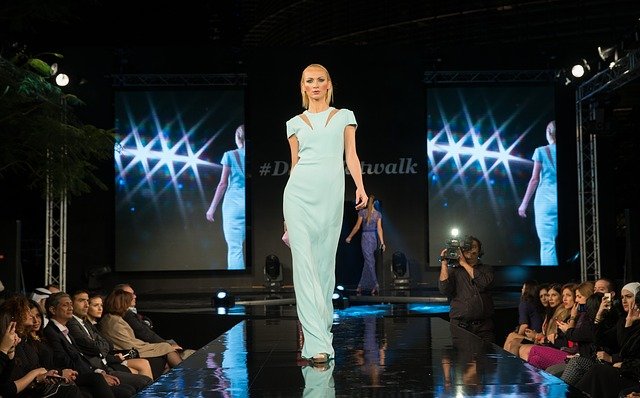
There is a moment when fabric, released from the tyranny of the straight grain, begins to behave like liquid. That is the territory of the bias cut — a construction technique that remains, a century after its refinement, one of the most radical propositions in dressmaking.
Cutting fabric at a 45-degree angle to the weave — along the bias — unlocks a property that straight-grain construction suppresses: stretch. Where a woven textile ordinarily resists deformation, the bias introduces a controlled give that allows a garment to follow the body’s contours without the intervention of darts, seams, or elastic. The result is a silhouette that appears to have been poured rather than sewn.
The technique reached its apotheosis in the hands of Madeleine Vionnet, the French couturière who, in the 1920s and 1930s, abandoned the rigid corsetry of the Edwardian era in favor of a geometry that worked with the body rather than against it. Vionnet’s method was painstaking: she draped directly onto miniature mannequins, sometimes using over a thousand pins per dress, and allowed the bias-cut panels to fall in uninterrupted arcs. The garments she produced — sinuous, columnar, often backless — moved with a fluency that astonished her contemporaries.
The structural logic of the bias cut is counterintuitive. A straight-grain skirt falls in predictable vertical folds; a cross-grain skirt holds its width; but a bias-cut skirt responds to gravity and movement in ways that cannot be fully anticipated during construction. The hemline, cut on the bias, develops a characteristic ripple — a scalloped edge that dances with each step. This is not a flaw but the entire point: the garment negotiates its own relationship with the wearer’s anatomy in real time.
Contemporary designers have approached the bias cut with varying degrees of reverence. John Galliano’s work at Dior revisited Vionnet’s logic through a lens of deconstruction — exposing seams, leaving edges raw, treating the bias not as a hidden structural device but as a visible aesthetic. Halston, in 1970s America, reduced the bias cut to its essence: a single seam, a cascade of liquid jersey, a body moving through a room. More recently, the technique has been absorbed into the vocabulary of red-carpet dressing, where the bias cut’s ability to skim the body without constricting it makes it a perennial choice for evening wear.
The bias cut demands more of its materials than straight-grain construction. Not every fabric is suited: it requires a weave with sufficient tensile strength to hold its shape at an angle — silk crepe de chine, charmeuse, and satin are the classical choices. The cutting itself consumes more yardage, since pattern pieces cannot be nested as efficiently. And the hanging process — the critical interval during which a bias-cut garment is allowed to settle under its own weight before hemming — can take days. These inefficiencies are not tolerated in mass production, which is why the bias cut remains, in its pure form, a marker of couture-level craft.
Culturally, the bias cut represents a shift in how fashion conceives of the relationship between garment and body. The corset imposed an architecture onto the torso; the bias cut negotiates with the body’s existing architecture. It belongs to the same lineage of thought as the brassière, the leotard, and the body-con dress — garments that seek not to reshape but to follow. In this sense, the bias cut is a philosophical position as much as a technical one: an acknowledgment that the most powerful clothing does not impose form but reveals what is already there.